 An altar with Linear A symbols in the excavation of the Minoan palace of Zominthos
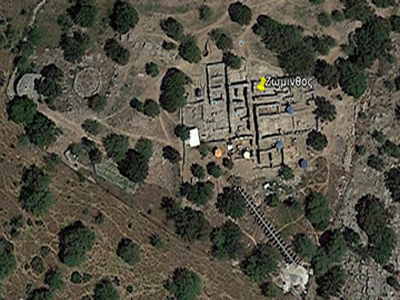 Important archaeological findings were discovered in recent years during the excavation of the Minoan palace in Zominthos, at an altitude of 1200 meters in mountain Psiloritis (or Mount Ida), Crete, which is being continued by the archaeologist Dr. Efi Sapuna-Sakellaraki.
"A great administrative, political and religious center, luxurious seat of the priesthood of Idaios Andros, was this palace" said Mrs. Sapouna-Sakellarakis. "Because its operation could not be limited to only the three months that, due to altitude, it is accessible. Thus, for the rest of the year the priesthood was established here in Zominthos" she adds.
At the same time he points out the productive functions of the palace, with the workshops of ceramics, metallurgy and crystal cutting, which have already been revealed - apart from the obvious management of natural wealth, of course. Control, however, seems to have belonged to Knossos. On the nearest road leading to Mount Ida and the Idaean Cave (Idaion Andron), which functioned as a cult center since the time of the first palaces in Crete, the palace of Zominthos was apparently controlled by the sovereign Knossos, who also had the sanctuary under her authority.
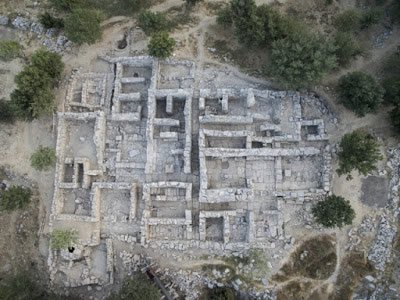
The building, with over 55 ground floor rooms, second or even third in a large part of the space, is the largest known residential center of the Minoan period on the mountains. A long corridor 17.40 m long (as far as the excavation has reached so far) and 1.55 m wide divides the palace into two wings, the east and the west.
"The entire eastern wing seems to have had a religious use," says the archaeologist. With an area of over 1,600 sq.m. the building had been constructed on the western slope of a low hill in a position commanding the entire plateau.
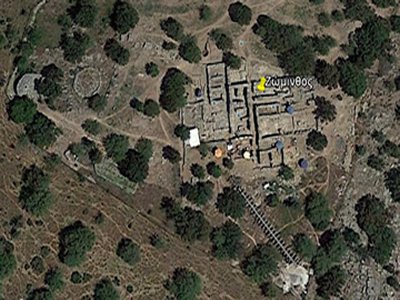
The area of the site amounts to approximately four acres, while the geomagnetic survey, which was also carried out in 2013, showed that around the palace there are many buildings of the settlement.
This site was identified in 1982 by the late archaeologist Dr. Giannis Sakellarakis, who, however, started the research in 2006. He was also an excavator of Idaios Andros and considered Zominthos, with its pre-Hellenic name, as a "Minoan uniqueness". After his death, in 2010, the excavations were continued by his partner Dr. Efi Sapuna-Sakellaraki.
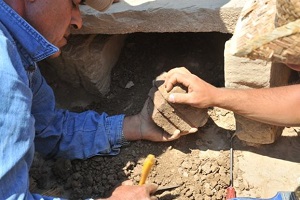
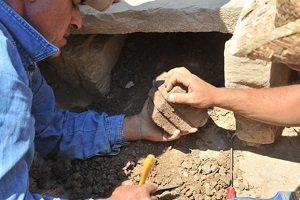
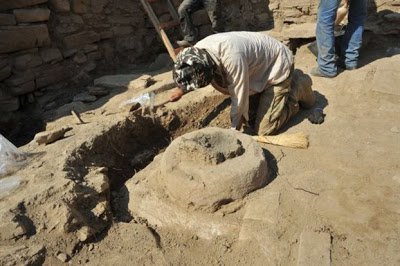
In the recent findings of the 2013 excavation there are various ritual objects, which are the first evidence to reveal the type of religious rituals that took place there 4,000 years ago. One of the most important finds was a stone stepped altar, with an unusual shape that was found well protected under a stone table resting against a wall. It consists of three stepped levels that grow from bottom to top, with a cavity on its upper surface. But the importance of this altar, of the Minoan Era, is due to the fact that on each of its sides - twelve in total - it is also engraved with a symbol of the Linear A script.
"It is a ritual altar, hence its small dimensions (20X20 cm)," explained the archaeologist Dr. Efi Sapuna-Sakellarakis who brought it to light during the excavation of the huge building complex of Zominthos.
"Studying it and trying to read the symbols is something that will take time and will certainly be done by scientists, experts in Minoan writings, in the hope that important evidence may be revealed about the rituals that took place at an altitude of 1,200 m before 3,500 -4,000 years. After all, the altar was not the only ritual object that was discovered this year: a series of nearby finds amply prove the sacred character of the complex, which beyond any doubt is now characterized as a palace."
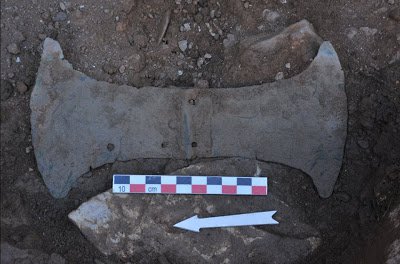
A room that hid impressive finds, such as are found only in sanctuaries, is the other great discovery. Because in one corner of it a semi-circular space bordered by upright slabs hid a real treasure: a copper censer with a handle, two copper double chisels and a smaller one. Also, two imitations of a chisel and a sword, also bronze, and below them a number of clay vessels. All the ritual objects that Mrs. Sapouna-Sakellarakis together with the late Yiannis Sakellarakis had previously located in Idaion Antron and in the summit sanctuary of Kythira.
But the findings don't stop there. A second stone ritual altar was also found inside this area, but sufficiently burned by the fire, so that it is impossible, at least at the moment, to determine whether it also bears engraved symbols. Finally, wild boar's teeth were also placed around the stone partition, while the horns of goats and a deer were scattered in the room.
"This is a typical altar environment," explains the excavator, pointing out that in this room, under the table, the altar with the symbols was also found. Also characteristic of Zominthos is the fact that all ritual vessels have been found carefully stored. "They had a religious conservatism in the Prehistoric Era, so they kept all ritual objects, even from the earliest times, as sacred relics," he adds.
In addition, he specifies that there should have been several altar areas in the building, possibly with some differences between them, in order to cover all the rituals. The proof is in another room of the palace, which preserves on one side of it a higher level of special use, a kind of altar to which one ascends by a small ladder.
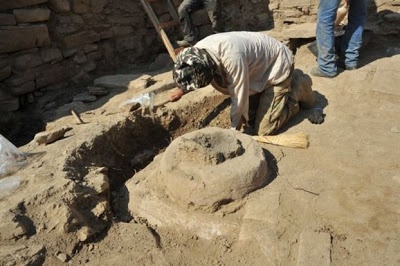
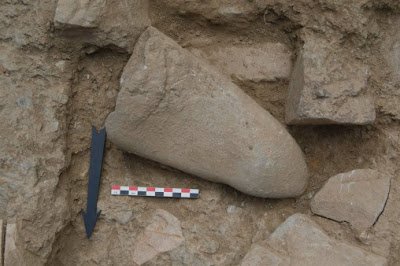
How long can wood be preserved? An answer is provided by the find located on the other side of the room of tables and stone altars (a wall that does not close at its ends divides the room in two). It is the base of a stone column, initially square, with dimensions of 70x100 cm wide and 15 cm high, and then cylindrical (55 cm in diameter and 17 cm high) used as a holder for the wooden column. At a height of about 30 cm and with a diameter of 26.5 cm, this wood is thus preserved in its place, which the Minoans had apparently cut from the mountain where they were and was famous for its timber, in order to construct the building.
It is also known that all Minoan palaces were built in this way as the use of wood allowed the light superstructure to be able to add two and three floors. This particular one was removed with great care in order to preserve it, while Mrs. Sapouna-Sakellarakis reminds us that a similar find had been brought to light during the excavation of Archana, at the entrance of the palace.
In one of the rooms on this side, a three-legged clay bench with blue mortar was found, while in another, a group of bronze objects of religious use came to light, including double chisels, devotional manuals, but also a long, narrow bronze object, of as yet undetermined use, with a hook at one end of it.
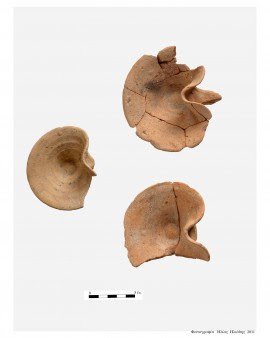
Here should be added all the other great finds of recent times, such as the bronze figurines, the priest's scepter with the engraved snakes, the censers, the bronze manuals and the bronze cups, the animal-shaped rytas, the communion cups but and many votives, prongs and periapts, jewels, plates.
The volume of mortar resulting from the excavation is enormous. Especially the walls of the rooms on the upper floor, not only had good quality mortar, but were also well painted, as can be seen by the colors that come to light: red, yellow and blue. But it will be possible to talk about the performances after the preservation of the frescoes - although already, in a small part of them, some branches and a bird can be seen.
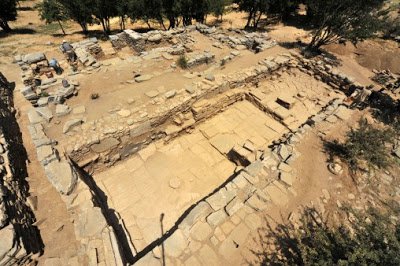
Another valuable piece of information from the excavation also emerged from the cleaning of the courtyard area on the north side of the building where the beginning of two processional corridors of the palace was identified.
It was built with large one-meter-long blocks, and all its floors were well paved with nice, large slabs. The palace of Zominthos seems to have had a genius architect with a special knowledge of the function and use of the spaces, as the archaeologist Mrs. Efi Sapouna-Sakellaraki, who is conducting the excavation, says.
The findings show that it was built in the prepalatial years (2100-1900 BC), since inside the building are preserved as "islets" relics of that period which were incorporated into the next phase of the palace by the later residents - now in the Palaiopalatial period.
However, after the earthquake of 1700 BC. about, which caused great destruction, the building was abandoned by its inhabitants, who left taking their possessions with them. Evidence suggests that they returned quickly, within 30-50 years at the most, and then rebuilt the building, slightly altering its layout. A few centuries later, however, another earthquake caused greater destruction. But the people returned once more... and rebuilt. Then the Mycenaeans came, the Romans came, then the Byzantines, the Venetians, the Turks, all of them leaving their footprints on Zominthos, but in no way did they succeed in surpassing those of the first Minoan inhabitants.
During 2016, the excavation continued under the direction of Mrs. Sakellarakis with a large number of personnel from various specialties. The excavation showed that the central building before its main phase (around 1750 BC) which was known until today, extends over a larger area during the immediately preceding period.
Corridors, staircases, new colonnaded halls are added to the magnificent spaces that had been revealed in earlier excavation periods and were completed this year with porticoes and skylights. The building was two or three stories high in some places. The walls, which are preserved at a height of 2.5 to 3 meters, are frescoed.
Meeting rooms with desks around the perimeter have been found, an element interpreted to mean that the building was not only a luxurious residence for important figures of the Knossos dynasty, but also a place for religious gatherings during times of the year when the neighboring international religious center of Idaean Cave was not accessible, due to weather conditions. The multitude of objects, bronze religious objects, such as double chisels, censers and other objects, indicate the religious use of this space.
Tributes such as seals (this year's were particularly important with a representation of a "sacred knot" and a stylized bucranium with a solar disk), bronze figurines of worshipers, necklace beads, but also other items, such as clay censers, fruit bowls and a number of special vessels confirm this use.
 The Minoans, who took advantage of the wealth of Psiloritis, had organized workshops for the production of ceramic works in Zominthos, as shown by the ceramic workshop and the kiln, the workshops for the processing of crystal ore, material that exists in the area and the metallurgical furnace, which was revealed during this year's excavation period . The number of coppers found this year is no coincidence.
Objects from Mycenaean times were also found, sporadically in the area, which show the relationship with the Mycenaean settlement that was discovered by Giannis Sakelarakis, 100 meters further east, while its use in historical times is confirmed by architectural remains (Roman) and mobile findings that indicate the timelessness of the space, just like the neighboring Idaean Cave.
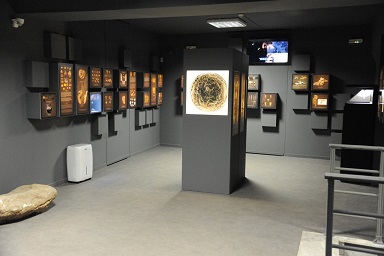
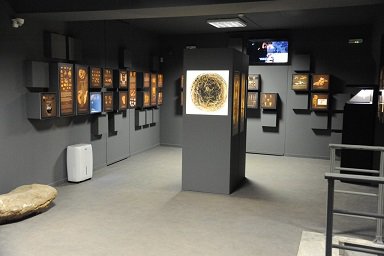
Since there are no guards, the findings of the excavation go to the Rethymno Museum. But in a neighboring village, in Anogeia, with the assistance of the Municipality of Anogeia, there is a pioneering digital museum that was set up by Efi Sapouna-Sakellarakis and includes the entire history of the excavations of Zominthos and Idaion Andron. In particular, three LCD screens have been installed inside the space that show documentaries with material from the excavations of Idai Andros and Zominthos, two hologram exhibitions that reproduce digital copies of excavation findings, an interactive table containing digital applications and educational games and an interactive display dedicated to in the findings of the excavations. Particularly impressive is the central three-dimensional (3D) cinematographic projection, which projects a stereoscopic documentary, which follows the route from Anogeia to Idaean Cave.
The Municipality of Anogeia believes that this is a strong development project for the region, whose benefits to society will be multiple. This happens due to the excellent depiction of the area and especially with the modern technology used, which manages to transport the visitor in an amazing way to Minoan antiquity and to the role played by Psiloritis and Idaean Cave, in the creation of this great civilization.
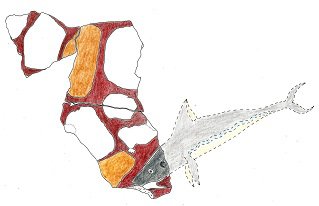
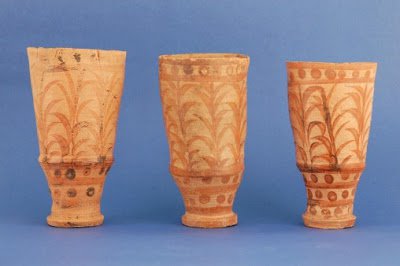
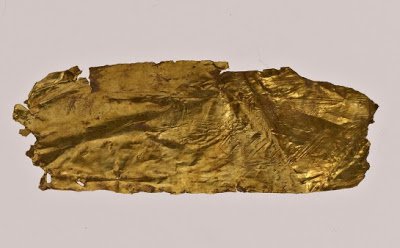
Below are various findings from the 2013 and 2016 excavations.

Sources: To VIMA (www.tovima.gr), Y.P.P.O (http://www.yppo.gr), http://www.iefimerida.gr
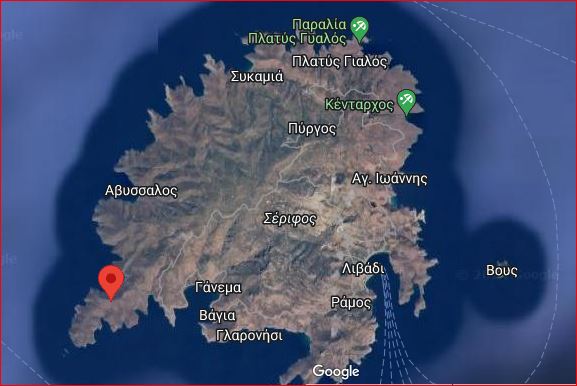
DILOS was considered to be a sacred island from ancient times. From this island, the most important heroes of the generation of the Atlanteans who later were deified, passed and left their traces. The sun-lovers "peoples of the sea" who came from the west, the "copper tribes", the Pelasgians, Leleges, etc. passed by. The Ancient Greek historian, geographer, "father of history", Herodotus notes that the first inhabitants of the Cyclades were the "Pelasgians," who later changed their name to Ionians. Among the first foreigners who came to Delos were Asteria, the daughter of the Titans Coeus and Phoebe. That is why Delos in ancient times was called Asteria. (The same name was taken at times by Crete and Rhodes). It is not excluded that the Titan Coeus was the leader of the Atlanteans who conquered the islands and gave them the name of his daughter, Asteria. Later, Leto came to Delos, the sister of Asteria, by her father, Titan Coeus, of the Atlantic generation. Poseidon brought her to give birth to the children of his brother, Zeus, secretly from Hera. That's why it stabilized the island that rocked by earthquakes and covered it with a dark water dome. There, Apollo and Artemis were born. Their birth was attended by Dione, Rhea, Ichnaea, Themis and Amphitrite, who formed her sequence, as Poseidon defined it, and all were of the generation of the Titans and Atlanteans. Iris, she was also Atlantida, brought, by flying, Eileithyia to help Leto at birth ... Poseidon was worshiped especially in Delos for the above reasons, but also as a protector of foreigners. (Was it the Atlantean colonists?). On "Delos" were also worshiped, Hermes and his mother, Maia, daughter of the Atlas. One tradition says that the giant Orion (he was also a hero of Atlantis), fell in love with the Titaness Eos, grabbed her and brought her to Delos, where he sexually harassed her (Apolodoros Library, book I, 27, p. 21). In Delos, there were also remains of a settlement of the Neolithic period (in the mountain "Cynthus", which still maintains its pre-Greek name), as well as objects from the Minoan and Mycenaean periods. In the middle of the square there was a temple of Doric style, inscribed, in his architrave, "to Hermes and to Maia". There was also a memorial of the Nymphs (Nereids). To the right of the circular sacred lake was the hall of the "Koinon of Poseidoniasts" and the Stoa of Poseidon with the inscription "To the Posidio". There, hearby, there were many houses of wealth known as: "The House of Hermes", "the House of the Tritons and the Comedians", "the House of Trident", "the House of the dolphins", etc. In these houses are saved until today, on mosaic floors, colorful representations, tridents, dolphins, Tritons etc ... RHODES In the Greek island of Rhodes, among the oldest deities worshiped were Electra, the daughter of the Ocean and Tethys, who is often was regarded as same with the homonymous daughter of Atlas and Pleione, Pleiada Electra. But Pleiada Electra was a later heroine of the same generation. The worship of Electra (the daughter of the Ocean) might have been carried by the Telchines, who were sons of Cafeira (or Cafira), daughter of the Ocean. They came from the west, settled first in Crete and then in Rhodes. They were great artisan metallurgists. The Telchines collaborated with the Cyclops and constructed the Poseidon's tridend, which became an Atlantean emblem. One version says that Telchines and their mother Cafeira nurtured Poseidon. Another tradition says that Poseidon brought the Telchines, with their sister Alia and Amphitrite, from Crete to Rhodes. Poseidon raped Alia, who gave birth to the nymph "Rhodos" or "Rhode", from which the island was named (it also had the names Ofiousa, Telchinis, Asteria, Pelagia etc). Another tradition says that the numph Rhode (or Rhodos) was the daughter of Amphitrite. There was also a temple of Amphitrite (found on the hill of Saint Stefanos). Rhode escaped from the flood because he left with the Telchines who predicted him. Later, Rhode returned to the island and married the new chieftain, the sun god Helios, who also came from the west with the Heliadae. "These were sun-lovers," Hesiod says, "just like the previous colonizers of Rhodes". The Ignites (or Gnites) Rhodians - that is, the original prehistoric Rhodian natives - attributed their origins to the Telchines. According to Greek mythology, the "Gnites" were six brothers sons of the god Poseidon and the sister of Telchini, Alia or Cafeira or Lefkothea and lived on the eastern side of the island. Triopas (or Triops), the subsequent colonizer of Rhodes, was also a son of Poseidon and Canake, daughter of Aeolus, who was a descendant of the same, with the above, generation of Atlanteans. SYMI (or SIMI) The Greek island of Symi of the Dodecanese had been linked, according to traditions, with the "gods" and the leaders of the West from the years of Saturn (Cronus). Some wandering researchers, from the fortunate isles of Cronus, arrived on this island having with them the nymph Symi, who stayed there and gave her name on the island. Poseidon, who passed a little later, made her own and thus was born Chthonius. Later, Prometheus, brother of Atlas, arrived and taught many arts and longevity. It is said that there he made a man of clay ... From "Cronus State", Glaucus, the son of Hermes, also arrived at SYMI and taught shipbuilding. It is said that he also designed "Argo", the ship that the Argonauts boarded for their expedition to Colchis. Glaucus married Symi, daughter of Ialysos, granddaughter of old Symi. There once was a sanctuary of Poseidon on the island. KOS At the island of Kos, the hometown of Hippocrates, they had once gone, chased by the gods of Mount Olympus, those who escaped from the Giants and Titans, with offspring of their generation. They seem to have called the island, Meropi, as it was in the very old days, which was the name of a Daughter of Atlas. While the city was called Meropis. Later they named it Nymphaea (from the Nymphs of the same generation), then Karfis, Kouris and finally Koa - Kos. After the Giants, the Pelasgians, Leleges, Carians etc. settled in Kos. The Dorians invaded it, in the 11th century BC, establishing a Dorian colony with a medium contingent of settlers from Epidaurus, whose Asclepius cult made their new home famous for its sanatoria. SAMOTHRAKI (or SAMOTHRACE) 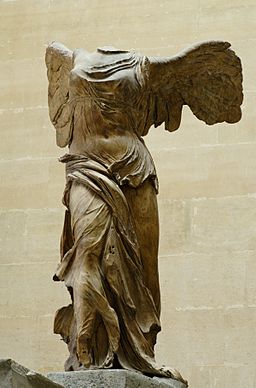 Marie-Lan Nguyen, 2007, Loubre Mus. Samothraki hosted glorious personalities from time to time. When the Argonauts arrived on this island, it was called "the island of Atlantidha Electra" (Apollonios Rhodios, p.45). Electra was one of the daughters of the Atlas and Pleione. The Atlanteans colonists installed her there, apparently, as their observer. According to tradition, Electra together with Zeus gave birth to Dardanus, who later conquered the Dardanelles, etc., to Iasionas, to Harmony and Imathion, who became King of Samothrace. This was followed, according to tradition, by soldiers like giants. In Samothraki, the Cabeiroi were later settled, followed by their relatives Pelasgians. Its inhabitants honored and worshiped, from ancient times, the Great Goddess (Gaia or one of Titanides). On the island are still preserved considerable remains of Cyclopean walls as well as of the "Sanctuary of the Great Gods", where mysterious rites (Samothracian or Kabeirian Mysteries) took place which were open to both slaves and free people. At the entrance to the sanctuary, which has been thoroughly excavated, there were once also, two phallic statues similar to Hermes (phallic Hermae)(see "Mythology of Greeks" by Karl Kerenyl, p. 99). The famous marble statue of Nike, now known as the "Winged Victory of Samothrace" (located in the Louvre Museum in Paris), with the wings and the Caduceus of Hermes or Iris, also of the Atlantean generation, symbolized the bond between the ancestors and their offsprings. Nike, according to Hesiod, was the daughter of Titan Palanda ... SKYROS In Skyros, the traditions for the Nereids and the Nymphs are still preserved. Close to the port of Achilleion there is a picturesque harbor, which the locals call it "Nyfi". They once called it bay of "Nireus and the Nymph" (Nymph - Nyfi). There, Nereus once installed his daughters, the Nereids. Among them, says the tradition, the Greek hero Achilles was hiding, dressed as a nymph, but Odysseus discovered him from his hairy hands and took him to the campaign against Troy. Another tradition says that Theseus, the king of Athens, died in Skyros when he was thrown from a cliff by the local king Lykomedes. On the back of the "Nyfi" is the Eirena bay (formerly the bay of Sirens-Sirena.) On top of it, on the mountain that enters the sea, there was a temple of Poseidon. Its ruins and remnants of cyclopean walls were found. LEMNOS In Lemnos, as Thucydides testifies, remains of Pre-Hellenic and Pre-Hellenic inscriptions were found at that time. A legend says that the Amazons once occupied it, who had Myrina as a queen. She allied with the Atlases against the Gorgons ... Another tradition says that Hephaestus once lived in Lemnos. The "Volcanoes" that were celebrated by the Lemnos were an old and strange celebration. Six days ago, all the fires were extinguished on the island and fired by a ship from Delos. (see "Greek Mythology", p.347, Jan Rispen). LESVOS LESVOS, before it was called Ethiopi, Makaria, Pelasgia. There, the "Elmnios" Neptune was worshiped. At the edge of Kalloni bay there was an ancient city called Pyrra. It was built by the Pelasgians, or the Aeolians, in memory of Pyrras, the wife of Deucalion, who was the nephew of the Atlas and the father of the Greek. In Pyrra, the poet Alkaios lived exiled later ... In the Milos, Poseidon was worshiped from ancient times. Its inhabitants had built a marble statue of 2.17 meters high to honor him. (Located in East Berlin Mo235). He is magnificent as a powerful leader ... NAXOS In Naxo, there was a tradition that Titan Kedalion, the famous metallurgist, was Naxios. Kydallonas had relations with the Giants and the Cyclops, and he taught his art to Hephaestus. Kydallon was Orion's driver when he was blinded ... NISYROS In NISYROS, according to a legend, was formed by a huge loop that Neptune hurled against the Giant Polyvotos. Poseidon was trying to sharpen him with his trident. Because he did not get him he took a huge loop from Kos. He threw it over him, and became an island! (perhaps, it is an ancient memory of the formation of the Aegean). MYKONOS In MYKONO, he was saying a tradition, the giants killed by Heracles had been buried. Poseidon was also worshiped in Mykonos (see book "MYKONOS-DILOS" by Petros Themelis, antiquities editor). CHIOS The first settler of the island was considered to be "Chios", the son of Poseidon or the Ocean. There is, from ancient times, a cape named "Poseidio". Later the Pelasgians settled on the island... ASTYPALAIA The Greek mythological figure "Astypalaea", the sister of "Europe", was one of Poseidon's mistresses, who gave her the homonymous island. Astypalaea with Poseidon gave birth to Argonaut "Ancaeus", the founder and king of Samos and "Eurypylos", who became the king of Kos. SAMOS At the island of Samos there was also a sanctuary of Poseidon and a cape called "Poseidio" to date, as well as a village named "Poseidonion". Its inhabitants were the Pelasgians, Leleges, Carians, etc. The colonizator and builder of the island is considered to be Ancaeus, who had taken part in the Argonautic expedition and reigned on the race of the Leleges (who were settled in Samos). Ancaeus was born from Astypalaea and Poseidon near the waters of Imvrasos river. With his wife "Samia", the daughter of the river's god "Meander", he acquired five children. One of the sons of Ancaeus and Samia was called "Samos" from whom the island took its name. The prehistoric presence of the island, according to current archaeological data, begins with the foundation of its first prehistoric settlement on the rocky hill of "Kastro" at Tigani - today's Pythagoreion - during the Late Neolithic Era (about 4500 BC). The end of this Neolithic settlement coincided with the dawn of the Bronze Age, and it seems that it surrendered a little later, the baton, to the first bronze settlement of Heraion that was founded near the Imvraso River and 7 km west of the Neolithic settlement. These two settlements unequivocally document, with their extensive excavations, the long and important prehistoric route of Samos. The German excavations from 1911, which have continued to date, brought to light impressive buildings and votive offerings, revealing the history of the holy site of Hera, from the Early Iron Age to the Roman Period (1050 BC - 400 AD.). The sanctuary of Hera flourished particularly in the 6th century BC, during the administration of tyrant Polycrates. From the deepest sections that have been excavated in various places, under the foundations of the holy site of Hera but also north of it, were found prehistoric architectural installations (dwellings, ceramics, metallurgy and weaving workshops, altars, monuments), fortification walls (about 2200 BC), and six prehistoric structural phases of habitation were discovered from the Early Helladic period in the third millennium BC to the last Late Helladic period (around 1100 BC). KARPATHOS In the island of Karpathos, in the antiquity, there was the city of "Posidius". Remains are still preserved. TENEDOS The first settler and king of the island was considered to be the "Tenes", grandson of Poseidon. SERIFOS In Serifos a cave was called "The Cave of the Cyclops". A bit higher, in the SW corner of island, lies the "Throne or Couch of Cyclops". The so-called throne, also called "Psaros Pyrgos" by the locals is a medium rectangular structure consisting of long, chipped shales, of a total length of 8.4 meters and a width of 4.2 meters. It really does look like a giant couch or armachair from the shape of the chipped boulders and it is worthy of wonder how these huge carved boulders have been raised up there. The "Cyclops Couch" is located in a position with a panoramic view on the southwest side of the island and stands like a guardian of the "Megalo Livadi" cove on the so-called "Cyclops Peninsula"
When he grew, he protected the island from the Gorgons. He also campaigned against them and captured and beheaded their queen, Medusa - Gorgon. When Perseus returned with the head of the monster Gorgon in his sack, he found his mother Danae at the altar of the temple. He had resorted to the altar to avoid King Polydektes, who wanted to marry her by force and he threatened her. Perseus was angry, and as he was horrified, he took out the terrible head of Gorgon, showed it to Polydektes and his people and stoned them! Since then, Serifos is all over stony. There was found also a 6th-century Serifos coin of the old chronology, with the representation of Perseus and Gorgon. Iron and copper mines existed on the island since antiquity, and metallurgical activities date back to the Early Cycladic period (3rd millennium BC). RINEIA(or RHENEA) In Rineia there are traces of habitation from the 5th millennium BC. It is located almost to the west of the much smaller, Delos. Rhenea became known in the historical era when, in 530 BC, it was conquered by the tyrant of Samos "Polycrates", who "dedicated it to Apollo of Delos by chaining it to the famous Delos" (Thucydides). Rineia was formerly called Ortygia. It is said that Ortygia, sister of Leto, had inhabited this island and gave it her name. Ortygia, also called an island of Esperides (in the Atlantic Ocean), where Orion hunted and Artemis shot him. Another tradition says that Ortygia was formed by the fall, in the sea, of Asteria, daughter of the Titan Coeus, who resided in the homonymous island, today Delos (formerly named Asteria). Was it spread in the Aegean by the Atlantes, the memory of a star or meteorolith that fell in Atlantis? Because it is said to have contributed to its collapse, not only volcanoes, earthquakes and torrential rains, but also the fall on its territory of an asteroid. ANDROS In Andros, in the ancient times, a mountain, a settlement and a valley, were called Arne. The name is inherent in a sea goddess. Arne was also called the Kourotrophos of Poseidon. TINOS In Tinos, the oldest worship belonged to Poseidon and Amphitrite. In the place "Kionia" was found their sanctuaries and a statue of the two "gods" height of about 8 m. A work of the Athenian sculptor "Telesias". Indeed, these two temples during the historical times developed into a medium religious center where the pilgrims of the sacred Delos stopped here first for cleansing. Also found, a marble sculpture dolphin, a relief of the god Cybele etc. In the village of "Steni" there was also "Antro of Aeolous". KEA In Kea there are Cyclopean walls and related traditions... SYROS In Syros there was a town, Poseidonia, where Neptune(Poseidon) and Amphitrite were worshiped. Its ruins have been found near a beautiful coast, which today, also, is called Poseidonia... KALYMNOS In Kalymnos, the Cave of "Seven Virgins" was discovered, reminiscent of the seven Pleiades, daughters of the Atlas, who organized the first night celebrations with the "dances of the seven virgins" as they called them. In the Cave there were various votive offerings and vessels of prehistoric times. In Telendos, submerged ruins were discovered, and in "Emborios" Cyclopean walls of the Pelasgian era or earlier. Originally the name of the island was "Kalydna", while from the 4th c. B.C. and then renamed "Kalymna". During the Byzantine era the name "Kalymna" changed to Kalymnos. As the archaeological findings reveal, Kalymnos is already inhabited since the Neolithic era. Ancient sources (Strabo, Diodorus Siculus) as well as various finds, testify that the most ancient inhabitants of the island were Carians. The Phoenicians succeeded them, and later it was inhabited by the Aeolians from Thessaly, to be succeeded by the Dorians colonists from Southern Greece (1150-800 BC). The leader of the Dorians was named "Thessalus", the son of Heracles and Chalciope. General conclusionsThe traditions for the relations of almost all the Aegean islands, with the related tribes of the Titans, Atlanteans and Giants, the Sons of Poseidon and the Pelasgians etc, are not exhausted here. Do not forget that the names Kalymnos, Thassos, Imvros, Karpathos, Crete, Kos, Lesbos, Naxos, Samos, Skyros, Tenedos, Chios etc are pre-Hellenic names (see "HISTORY OF GREEK LANGUAGE", NP. Andriotis Professor of Philosophical School , pp. 9-10). Pelasgus, the Pelasgian leader, was also held by the same generation of Atlantes and Poseidon. His wife was the Oceanide "Melivoea". Poseidon was considered to be a permanent resident of Atlantis, but had the surname Pelagios, Pelagaios and Aigaios. Because he was also dominated the open sea of the Aegean. In the Aegean, he stayed for a long time, on a strange island, with his wife Amphitrite and her sisters Nereids (see "Iliad" of Homer, Θ. 203 and Strabo K. 405). In the Aegean, for a while, the wise old-Nireus, of the Atlantean generation, also lived, who led Heracles to the Atlas to get the "golden apples" of Hesperides (see "Argonautica" Apollonius of Rhodes) ... Of course, many of these traditions refer to mythologies. Plutarch also writes: "I wish the mythical was cleared up and it would come out of it with logic a historical reality."
|
Crete has a long history that preceded the Homeric world and she shone with the culture that developed from ancient times. This first became famous with the names: Dolichi, from its oblong shape, Leria, Macaris or Macaronisos (Island of the Blessed), Asteria, Telchinia, Ideon, Chthonia (mainland), Kouritis, Kaptara or Caphtor and Keftiu. The name Crete which prevailed, comes, according to tradition, from the name of a nymph-Hesperida, who arrived on the island from the west with Talaious (Talea Mountains of Crete), or Telchines, or Kourites, who came with Rhea, to give birth to Zeus, away from Kronos state of the Titans (Atlantis). The nymph Crete stayed on the island and the strangers forced her to locals as their first queen. A tradition says that the nymph Crete had a sister, called "Omonia", and her mother was "Praxidiki" daughter of Ogyges, also Atlantic generation. The name Crete could alsο comes from the Kourites, who banged the brass cymbals not to be heared the cry of Zeus, because they also referred to her as a daughter of a Kouriti. But, additionally, Kourites was "non-native" (foreigners who came from the outside), as Telchines and Cabeiri. They brought a great discovery, that was the processing of copper, in Crete and in the other islands of the Aegean and accepted by the locals {see Manolis Andronikos: Iraklion Museum}. Crete is mentioned also as a daughter of Deucalion ... From that years begins the cultural prosperity of Crete. It was continued by Pelasgians and Aegeans who conquered Crete to be joined with their predecessors and locals, so Eteocretans presented. Αn inscription of this prehistoric Cretan people was found, with Greek letters in an unknown language (kept in Crete Heraklion Museum). Residues of some skeletons of Crete indicate organic blending of ancient Cretans Pelasgon etc., writes M. FINLEY in his "Odyssey book". Asterion, the well-known King of Crete, who also comes from the generation of the Titans, is considered a mythical and historical person. Asterion married Europe and became the father of Minoas, Rhadamanthos and Sarpidonas. The period of the Minoan dynasty and the sovereignty of the Cretans in the Aegean Sea follows. For this period, almost all the ancient Greek writers and the most famous Latins wrote and found relevant information in the Middle East, Egypt and elsewhere. J.V. LUCE in his book "The End of Atlantis" claims that old Crete was the cradle of Atlantean culture. The "peoples of the sea" and "the race of the copper" had a base in Crete, accepts LUCE, and these tribes were descendants of the Atlanteans of the old Crete. Hesiod, however, writes that they have come from the west from the outside Ocean, and Homer accepts that the Ocean is the generator of all of them. The most correct view, in our opinion, is that the Atlanteans has colonized Crete, like almost all of the Aegean islands. The Crete-related issues mentioned above support this view. We will reinforce it by mentioning some of the many finds of Crete, reminiscent of Atlantis and a few related traditions:
We will also mention some traditions indicative of Crete's relations with the Atlanteans and their descendants:
Near Knossos there was a river called "Triton". From Crete, the nymph "Europe" crossed the Aegean riding on a bull (it is the transformed Zeus in the legend) and is accompanied by Tritons and Nereids ... Iris flew from the island of Aeolus and found the wise Nireas, the lord of the Aegean. "Iris told Nireas, who had an interpreter named Glafko, to make sure that the Argonauts have a good trip when they will pass through the Aegean islands to go to Crete.The Argonauts wanted to steal the Talo's secret. Probably his mechanical kinetic system, perhaps related to the "Flying Ram" with the "Golden Fleece" of Phrixus and Helle. It is said that Talos, the guard of Crete, was a moving copper robot, with arteries and liquid, produced by Hephaestus or Daedalus and their assistant, of Atlantean generation. Talos is also depicted in Phaistos coins.
For more information on Crete and Atlantis we refer to J. LUCE's book "The End of Atlantis".
Copyright © by Theodoros Paschos, Greece, 2000
|
The findings of the Thira (or Thera) excavations from Marinatos and Chr. Doumas, date back to the times of the classical culture of ancient Greece, the Mycenaean, Minoan and another older civilization which is named "Aigaios, Aigaikos or Aigaiikos" civilization. The term Aegeo-pelagian civilization, which was established last, shows the continuity of the old culture with the classical ancient Greece and the new civilization of the inhabitants of the Aegean islands. There are, of course, certain characteristics that distinquish cultures with each other. But there are others that show the interaction of these cultures and several elements of the common root of their styles. What findings have been studied, from the old ones, dates back to the years 2700-2000 of the old timing. Other findings have been found that hαve not yet been studied. We think that some of those studied are older than the 3000 old timing, such as compasses, oenochoes, "kiosk-like utensils" etc. The use of the latter is still unknown ... That one of the findings of Marinatus, who did not take much care of, was a human denture found in Aspronissi, Thira. Its size betrays that it belonged to a giant man, at least two and a half meters high with similar body members. Is it related to someone "Atlas" from the colonisers Atlanteans of Thira? In the Archaeological Museum of Athens and the Thira Museum exhibited beautiful wall paintings of Santorini from the 3rd millennium until 1600 of the old timing. There is a colorful fresco depicting seven ships, surrounded by dolphins. The layout of the ships is reminiscent of disembarkation, after a naval battle, in a well-built city. It is certainly an illustration of an event, but of unknown chronology. Two beautiful colorful vases of Thira are painted with dolphin pairs. In a mosque of Thira was found a relief carved large dolphin in stone (and above ancient form). Do not forget that Pelagius Poseidon, father of Atlas, according to Plato and so on, was symbolized and portrayed with the Dolphin, worshiped as totems on islands beyond the Heracles columns and considered a sacred animal (Delfinios Apollo etc). Another tradition says that Poseidon often visited Thira, and there, on the islet "Sphere", met Aithra and Theseus was born. Also in Thira were found species of obsidian, which were used by the pelasgians and jars with embossed crosses. (residues of beer were found in two jars). Were also found buildings, one-storey, two-storey and three-storey, with windows of membranes-treated animal skins, white and thin, so that the light penetrates ... An ancient legend, saved by Apollonius Rhodios, reports that the island of Kallisti was formed by a clod of soil, which was thrown into the Aegean by "Thiras", the son of Triton, the nephew of Poseidon. From him, the island was later named Thira. Thiras and his brother Euphemus took part, also, in the Argonautic campaign. Euphemus even had respect for "Atlantida Maia", mother of Hermes, and imposed her worship on Thira because she was holding from her generation. Other traditions say that in Thira existed, in the ancient times, the temple of Saturn (Cronus) and another temple of "Asphaleios Poseidon". In Perissa there were sanctuaries of Hermes, Hercules, Serapis and Isis. All these factors convinces that long before the Thira was conquered by Minos (Crete), it had been colonized by other peoples of the sea, from the Pelasgians and older, apparently, from the Atlanteans...
Copyright © Theodoros Paschos, Greece, 2000
|
I wish the mythical would be clarified and a historical reality would come out of it with logic!
|
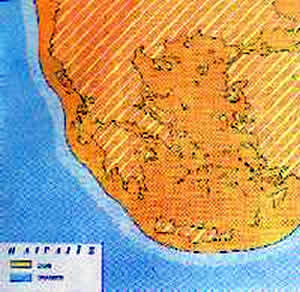
Aegeis was a compact mass of land stretching |
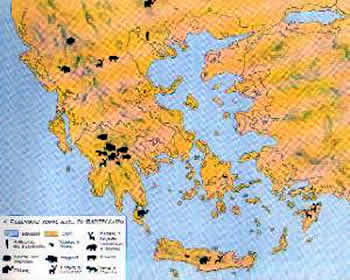
The form of Greece 400,000 years ago. The sea level |
According to this theory, Aegeis or Aegeida was a land from Crete to Sounio of Attica and Euboea. Later, it collapsed, from volcanoes and earthquakes, and the mediumst parts of the land sank into the chaos of the earth, and their area captured the waters that came from the Atlantic Ocean and from the Ethiopian Sea, or the "Tritonida" lake of the Sahara (Herodotus, Eratosthenes and other ancient writers write that the Sahara desert was once a lake and called it "Tritonida" or "Tritonid").
But if there are geological data for all of this, the shaping of the Aegean has to be hundreds of millennia ago. It can not be related, therefore, to the great eruption of the Santorini volcano, which had previously been identified in the 1450s of the old timing. At that time, he was backed by Spyros Marinatos and others, Knossos and the Minoan civilization of Crete were destroyed. Because, apart from the strong tidal wave that was raised by the eruption, there followed successive earthquakes that shook the Aegean Sea and brought about the destruction.
Sp. Marinatos could not prove from the findings of the excavations in Thira that Atlantis was in the part that was submerged in the Aegean Sea. Thus, Marinatos in his writings refers to "Enigma", or to "Atlantis Problem".
The priests of Sais, the ancient religious capital of Egypt, told Solon, who translated the evidence for Plato's "Atlantic speech", that the Aegean islands and Crete were conquered by the Atlanteans who came from the west of the Great Ocean. The powerful nation of Atlanteans, written on the plaques read by the priests, conquered almost all the coasts of the Mediterranean countries, from the north and south, and reached the Persian Gulf. The Atlanteans did not succeed in conquering Attica because their troops were defeated by the Athenians ... (ie, the inhabitants of Attica, at that time, who seemed to have some prosperity).
Most of the ancient Greek and Latino writers, such as Homer, Hesiod, Eumelos, Aeschylus, Pindarus, Herodotus, Elanikos and after Plato, Krantoras, Eratosthenes, Apollonius Rhodios, Aristarchos, Apollodoros, Posidonios, Plutarch, Ovid, Pliny, Strabo, Pausanias, Proklus, were agreed with Plato on the subject of Atlantis, indirectly or directly.
Most of the younger Atlanteans, from the Renaissance to the present day, headed by Ignatius Donellly, accept this last view, that the Aegean islands and Crete have been conquered in the ancient years by the Atlanteans. This view has many props, if we admit that Atlantis was once there, and then was lost by natural causes, of course, and not by "wrath of Zeus", as the priests of Saida translated the hieroglyphics in Solon.
The elements of the above theories refer to ancient times of the old timescale, before the great cataclysm that coincided, as many admit, with the collapse of Atlantis.
The researchers of the "Atlantis and Aegean" themes studied mainly the elements of Crete and Santorini. Corresponding elements and traditions exist in almost all the Aegean islands. Even the name "Aegean" is attributed to heroes and chieftains associated with the Titans-Atlanteans.
Aigaion was, according to Greek mythology, a giant (a Hecatoncheir), son of Heaven and Gaia. He was ancestor of the Titans. He dwelt in the depths of the Ocean. He was considered a marine god, but also an inventor of the ships. Of some, he is identified with Poseidon who was the ruler of the Aegean Sea, and he was called "Aegaeus" and "Aegi-oohos", because he was lounched the surging waves. These were called "Αίγες-Aiges=waves" (see the "Souda" dictionary), while "epaigizo" means "blowing very hard". The name Aegean, they conclude, is due to the wilderness of the waves.
Another version is that it comes from the seaside towns, named Aigai *, in Euboea and Achaea, where Poseidon was worshiped.
It is finally said that the Aegean Sea took its name from "Aegeus", the King of Athens, who fell into the sea, waiting for his son Theseus to return from Crete.
* The location of the ancient city Aigai has been found and excavated northwest of modern Aigeira in Achaea of Peloponnese.
Copyright © by


| Prehistory, Atlantis and "Gods": On Bluesky and Alter TV channels | |
I discuss on T.V. with L. Georgiadi (Bluesky, 8/7/2009) :1) Prehistory and Atlantis --- 2) The content of Vassilis Paschos book "The Atlanteans and Not the Gods" |
The view of "Atlantis Museum"My interview on the TV show "Gates of the Unexplained" |
Books Presentation |
||
Science Fiction
Author: Theodoros Paschos. Pages 320 Two Greek scientists with their technology find solution to the problem of communication with intelligent beings in the universe chasing the future of humanity. Seeking to solving various mysterious phenomena starring in Mission Teams to watch the flying saucers that appear on Earth to Mars and the Moon and to communicate with extraterrestrial beings. In doing so they get involved in adventurous and dangerous stories, but they also discovered the remnants of the technology of Atlantis into the ocean depth. You can preview or get the book from the Website: smashword.com/ |
The Atlanteans and Not the Gods
Author: Vassilis Th. Paschos. Pages 350 The author Mr Vassilis Paschos, with this book penetrates research into antiquity and by demystifying legends and traditions, proves the existence of the Atlanteans. For their original residence, the cradle of its culture, their lost country, the author quotes rich material and convincing facts ... |
Atlantes, Not the "Gods"
Αuthor: Vassilis Th. Paschos. Pages 80 The new and daring theory of Mr Paschos, is based on elements from Homer, Hesiod, Plato, Proklos, Plutarch, Markellaus and other ancient Greek and Latin writers (their works are mentioned in his book), on Egyptian papyrus, the Gilgames epic poetry of Babylonians, the Bible, the traditions of the people around Mediterranian and Central America and on ancient findings in these areas. You can preview or get the book from the Website: Smasword.com/ |

 A legend says that Perseus, along with his mother, was found on the beach in a wooden box. The King of Argos Acrisius had been shut up in the box, his daughter Danae and her infant son Perseus, and had thrown it into the sea to eliminate them because he had taken an oracle that his grandson would kill him.

 The Esperida nymph Crete is pictured with Talo and Daedalus and Icarus in a vase of Neapolis. In a fresco of Campania he stands with Theseus. In Villa Albany, in a sarcophagus fragment, she is depicted with Hercules, who catches the Cretan bull.