 |
The land of Atlantis and the flood in the apocryphal writings of Enoch |
The Book of Enoch contains texts of Enoch's secrets, and is considered apocryphal because it has not been recognized by either the Jewish or the Christian religions. This book is a collection of five texts written by Jewish authors, originally in the Hebrew language (according to others in earlier Aramaic), about the 2nd century BC, but the original does not yet exist. However, several fragmentary copies translated into other languages have been found at times. Although it was equally respected by the early Christians and the Jews, it was later criticized by the later church fathers and it was declared heretical mainly because its subject concerned the nature and actions of fallen angels. Eventually the book was lost (or conveniently forgotten) for thousands of years.
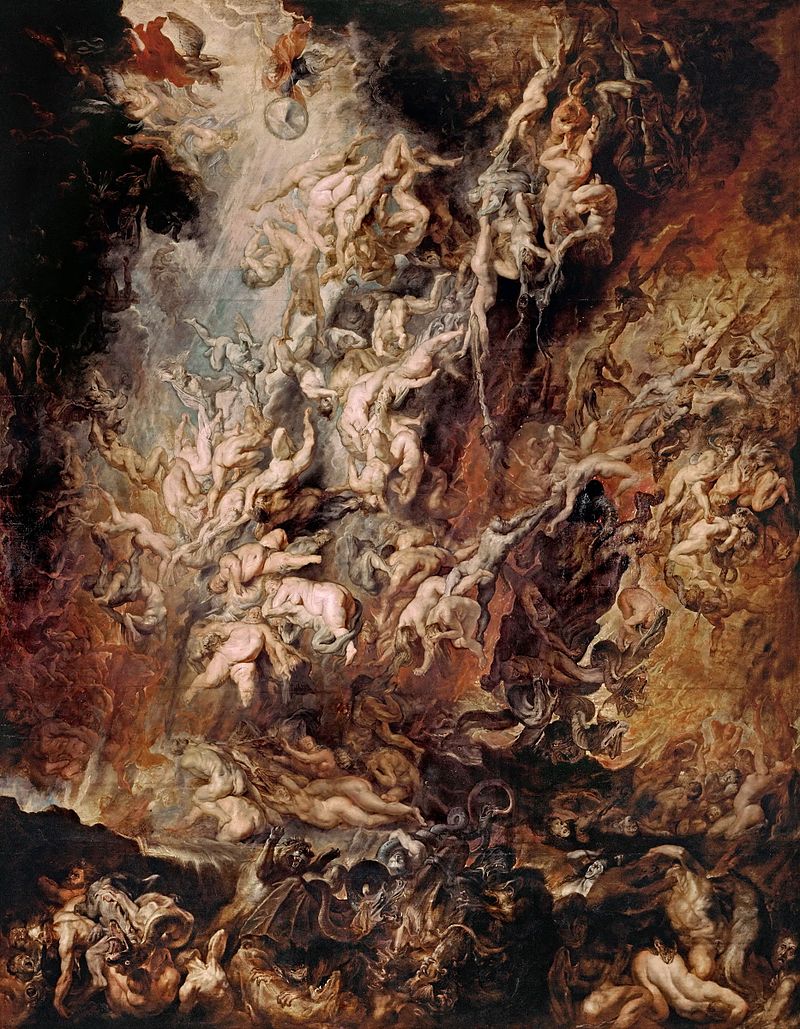
A papyrus containing a portion of these texts, in a Greek translation, was found in Upper Egypt. In its most complete form it is today in the Ethiopian library (in Ethiopic translation), and is part of the Ethiopian Church. Copies of this book were also found in the papyri of the Dead Sea Scrolls (of Qumran), which now prove that it existed long before the time of Christ.
In 1773 the Scottish aristocratic traveler James Bruce found a copy of it in Abyssinia, written in the Coptic language, and in 1821 it was translated into English by the Jewish professor Dr. Richard Laurence and then in other languages
Today it is considered that these texts were written by many authors, at different times. However, what these texts had in common was that they all included adventures (supernatural or not) of the biblical patriarch Enoch who had lived thousands of years before they first appeared. However, it is worth noting that in the book of Enoch there are also some traditions related to Noah, the grandson (or great-grandson) of Enoch. According to scholars, it is most likely that the first texts were written during the years of the captivity of the Jews by the Babylonians and this is because many of their descriptions, such as the "Ancient of Days", resemble corresponding descriptions of the prophet Daniel.
From what we know, Enoch was a highly interesting figure in prehistoric Jewish mythology, the seventh antediluvian patriarch after Adam. The legend presents him as being taken up alive (by god) into heaven after 365 years of earthly life, because he was a virtuous man. In his "Chronicles" Eusebius of Caesarea, one of the fathers of the Christian church, mentions that, according to the Babylonians, Enoch discovered astrology and that he was known to the Greeks as "Atlas".
Many passages of the Book of Enoch have an interesting meaning for Atlantologists, since they are an indirect indication of the existence of an idyllic land to the western end of the earth, and at the same time a direct reference to a great flood which destroyed it:
Enoch himself describes:
1) Take the passage where the holy angels (note—Th.P.: they are the non-rebels angels led by Uriel) shows Enoch a piece of land in a great sea to the west:
“…And angels brought me to the living waters and to the flame of the sunset, which receives every setting of the sun, and to a fiery river, where fire flowed like water, which flows into a great sea in the west. I saw the great rivers and I came to the great river and the great darkness and I came to the place where no flesh walks. I saw the mountains of darkness in winter and the place from which all the waters of the deep flow. I saw the mouths of all the rivers of the earth and the mouth of the deep…” [chap. 17, 4-8]
2) Ιn another chapter: Enoch's journey continues to a place even further west:
"..And from there I went to another place and the Lord showed me to the west another big mountain of solid stone, and there were four hollow places in it, deep and wide and very smooth (slippery). Three of them were dark (note—Th.P.: rift valleys?) and one was bright... "in the bright place there was a spring of water in the middle of it" [chap. 22, 1-2].
3) And further west:
"...and from there I arrived at another place located to the west of the ends of the earth" [chap. 23, 1]
4) The following passage describes an idyllic place with mountains full of precious stones, an acropolis at the highest point with fragrant trees and a royal palace:
“…And I went beyond it and saw seven wonderful mountains different from one another, and (their) stones were wonderful and beautiful, magnificent in their entirety, with the appearance of the glorious and the righteous outwardly: three toward the east, the one resting upon the other, and three towards the south, one upon the other, and deep rough ravines, none of which joined any other. And the seventh mountain was in the middle of them and was higher and looked like the seat of a throne (note—Th.P.: A citadel with a palace in the middle of an island?), and around it were fragrant trees, there was one that I had never smelled before, nor was there another like it. Its fragrance surpassed all other fragrances and never faded. And its fruit is beautiful and like that of the palm tree. .." [chap. 24, 1-6]
5) In the following passage Noah (Enoch's grandson) becomes an observer of the first physical manifestations of an impending great flood:
"And in those days Noah saw the earth that it had sunk down and its destruction was nigh.
And he arose from thence and went to the ends of the earth, and cried aloud to his grandfather Enoch.
Noah said three times with an embittered voice: "Hear me, hear me, hear me."
And Noah said to him, Enoch: "Tell me what it is that is falling out on the earth that the earth is in such evil plight and shaken, lest perchance I shall perish with it?" [chapter 65, 1-4].
And Enoch, my grandfather came and stood near me and said:
"Why Noah hast thou cried unto me with a bitter cry and weeping?
A command has gone forth from the presence of the Lord concerning those who dwell on the earth that their ruin is accomplished because they have learnt all the secrets of the angels, and all the violence of the Satans, and all their powers, the most secret ones.
And all the power of those who practice sorcery, and the power of witchcraft, and the power of those who make molten images. For the whole earth: And how silver is produced from the dust of the earth, and how soft metal originates in the earth. For lead and tin are not produced from the earth like the first: it is a fountain that produces them, and an angel stands therein, and that angel is preeminent." [ch. 65, 6-8]
6) From his grandfather, Enoch, Noah also learned that in those days of the impending deluge decided by the "Lord of Spirits" not only the sinful human race but also the fallen watcher angels would be punished.
They are the two hundred (200) "angels-children of heaven" (the author calls them "Erigors") who rebelled in violation of the Lord's law and descended during the days of Jared on the top of Mount Hermon, they called it Hermon because they swore and cursed each other on it. They mingled with the lovely daughters of men, each one choosing a wife, and began to enter them and pollute themselves with them, and great Giants were born, three thousand cubits in height, who devoured the labors of men. Their leaders, by scores, were twenty and the first was Shemiazas.
In chapter 8 it is stated that fallen angels exposed occult and divinely inspired wisdom to earthly women in an ungodly manner. Thus they taught men to make swords, and knives, and shields, and breastplates, and made known to them the metals of the earth, and the art of working them, and bracelets, and earrings, and ornaments, and the use of antimony, and the beautifying of the eyelids, and all kinds of precious stones and all dyes. And there was much ungodliness, and women committed fornication and were led astray and corrupted by their teachings. They taught them charms and rhizotomies, the solution of charms, astrology, the signs of the earth, the constellations, the course of the moon (Chapter 8, verses 1-4)
They taught them magic, potions, roots herbs, processing and use of metals, making swords, knives, shields, breastplates, ornaments, the first stages of science e.g. astronomy and the observation of the course of the moon and thus arose impiety, fornication, corruption, sin in mankind.
The rebellious angels were first imprisoned in the place to the west described above.
Enoch describes the destruction of this place with the following characteristics: continuous earthquakes, tsunamis, "boiling waters" and fiery lava:
" .... And he will imprison those angels, who have shown unrighteousness in that burning valley which my grandfather Enoch had formerly shown to me in the west among the mountains of gold and silver and iron and soft metal and tin.
And I saw that valley in which there was a great convulsion and a convulsion of the waters.
And when all this took place, from that fiery molten metal and from the convulsion thereof in that place, there was produced a smell of sulphur, and it was connected with those waters, and that valley of the angels who had led astray burned beneath that land.
And through its valleys proceed streams of fire where these angels are punished who had led astray those who dwell upon the earth.... " (ch. 67, 4-7)
In the above paragraph where I quote the contents of chapter 67 of the book of Enoch, the authors of the book describe in a veiled allegorical way the destruction of the land of Atlantis due to a cataclysm accompanied by a tsunami, continuous earthquakes and bubbling waters of fiery lava. It is presented allegorically as a "valley of angels whose people seduced humanity" and which was located to the west, near the mountains with the precious metals (gold-silver-iron, tin). Allegory for the purpose of concealing real facts is found in wide use among ancient peoples, as well as in the Christian Old and New Testaments.
Indeed, these Atlanteans-angels presented themselves as saviors-angels to the peoples (even in Judea-Babylonia) and taught them the arts, crafts, the principles of Science, etc. But, in the end, all these teachings corrupted and harmed the people of that time, according to the opinion, of course, of the Christian writers of the book of Enoch.
It should also not escape notice that the manufacture of warlike objects is regarded by the writers of the book of Enoch as the work of demons, as well as the discovery of the working of metals and the early stages of science, e.g. astronomy and the observation of the course of the moon. The first teachers of these arts to humanity are presented as angels-children of heaven who fell from the will of God, demons and monsters who seduced the human race and polluted it.
© Copyright by Theodoros Paschos, Greece, 2000


|
The Titan Atlas punishment by the "Gods" |
From "Theogony" we learn that Zeus cruelly punished Atlas either because he fought with the Titans (against gods) in Titanomachy, or because he was with the Titans who mangled Dionysus because he and his brothers generally ignored Zeus and did not want to recognize him as chief.
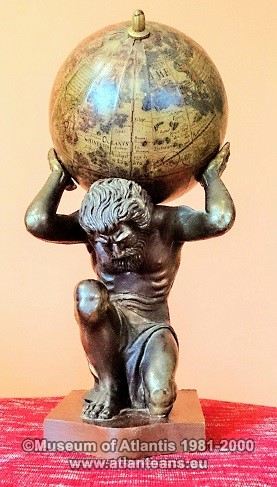
When the Olympian gods beat their opponents (Titans), Zeus exiled Atlas in the west of earth, where Hesperides guard the gold apples. That is the end of earth in front of the house of Night or the border of Chaos where were the roots of Earth and Pontus (the ocean) and Uranus and Tartarus. In this world Atlas's heavy duty was to hold in his shoulders, forever, the sky above earth or the sky and earth together or the column on which the sky and earth stand or the axis of the world.
From this place Atlas knew as it was said the depth of the sea and all the secrets of the sky and he was the first who figured out that the whole world was a big sphere.
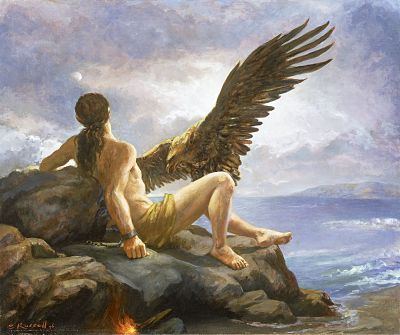
But Atlas's three brothers were punished as well by Zeus after "gods" victory in Titanomachy. Zeus crushed Menoetius and Epimetheus and Prometheus and sent them to Erebus while he put Prometheus in the east nailing him in the highest peak of Caucasus. Hephaestus tied him there on a rock with unbreakable bonds.
An eagle sent by Zeus went there every day to eat Prometheus's liver that was reformed the next day because Prometheus was an immortal Titan. After thirty years Hercules passed by chance through the region of Caucasus. He killed the eagle with his arrow and freed Prometheus's bonds. All these happened of course with Zeus's consent that became friend with Titan Prometheus. In fact Zeus accepts him in Olympus.
© by

|
The golden apples in the Hesperides Islands |
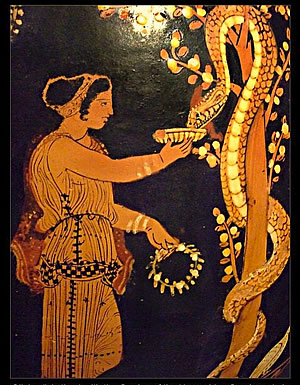
The "golden apples of Hesperides" were a wedding gift of Gaia το Hera (in her marriage to Zeus) and it was believed that they gave eternity and immortality. They were so delicious and fragrant that Hera ordered that their seeds be planted in her garden, "on the edge of the ocean, in the far west". The seeds germinated and sprouted trees that made golden apples. Near the Garden was the place where Atlas, the son of Iapetus, was holding on his shoulders the poles that supported the dome of the sky. In the garden were also the Hesperides, the three daughters of the Night (according to Hesiod), Aigle (or Aegle, "dazzling light"), Erytheia ("The red one") and Hesperethusa ("sunset glow"). Other ancient sources report that Esperides were four. On another source (see Petrus Apianus), however, "Esperides were seven and were daughters of Atlas and Esperis."
For no one to steal the apples, Hera put "Ladon" as a guardian, a huge snake that was the birth of Phorcys and Ceto.
We interpret the "golden apples" as being the fruit of the earth. If they were imitations of apples made of gold, they would not be planted. Nor could the seeds germinate and become trees. Golden apples do not exist. So they were the golden-yellow fine fruits, the citrons, the lemons, the oranges and the tangerines, which thrived in the Islands of Hesperides, on the edge of the Atlantic Ocean, and named them Citrus. The myth symbolizes the beginning of citrus cultivation but also the desire of prehistoric Greeks to acquire these sweets, tasteful and beneficial fruits, so they called them "golden" ...
The myth also reveals the existence of a cluster of prehistoric islands located in the far west (in relation to Greece) at the edge of the ocean, ie near the coast of Portugal or the southern Spanish coast, called Hesperides. The "Erytheia", which took the name of an Hesperida, was one of them. The myth of "golden apples" is also associated with Heracles' Eleventh Labour.
Copyright © by
|
The Titan Atlas in Greek Mythology |
Atlas was a mythical giant, the son of Titan Iapetus and Oceanid Clymene. His brothers were Prometheus, Epimetheus and Menoetius according to Hesiod' Theogony. But Hesiod says that maybe Iapetus and Asia, daughter of Oceanus and Tethys, gave birth to Atlas. We also learn from Hesiod that Atlas lived during the golden period that was the first of the five human generations (golden, silver, bronze, heroic and iron). Hesiod lived during the last one.
But many ancient writers say different things about the parents of Atlas. Apollodorus says that Atlas's mother was Oceanida Asia and his father was Poseidon. Eginus says his mother is Gaia and his father some god. On the other hand Plinius says (Nat. Hist. VIII, 203) that his mother was Libie and his father Ether. Plato says that Atlas, who became the central king of Atlantis, was the son of Poseidon and Cleitus.
If we look at the myths about Atlas's daughters, Pleiades, there is also confusion about them. The dominated point of view is that Pleiades were the seven daughters of Poseidon to whom he gave birth with Pleione. These were Maia, Electra, Taygete, Alcyone, Sterope, Celaeno and Merope. Because of them Poseidon named a constellation after them and its stars after the names of each one of them. Many writers refer to Pleiades as Atlantides or Hesperides or Oceanides, all daughters of Poseidon. But Apollodorus says that Hesperides were: Aigle, Erythia, Arethousa, Hestia and Hespera, the daughters of Atlas. Hesiod says that they were daughters of Atlas but he gave birth to them with Night or Themis or Ceto.
Also Calypso, who wanted Odysseus with her, forever, is referred to as the daughter of Atlas. Both Hyas and his sisters Hyades are said to be Atlas's children.
About his seven daughters, Pleiades, it is said they had mated with great "gods" (read: Chiefs) and they had given birth to gods and leaders. "After joining the greatest heroes and gods they made them kings of humans" Diodorus Siceliotis says about them (III, 60).
Maia gave birth to Zeus and Hermes, who was later deified, Electra and Zeus gave birth to Dardanus, who was the leaders of the Trojans. Pleiada Taygete dreamed Zeus (!) and in nine months she gave birth to Lacedaemon. Their names were given to the mountain Taygetus and the land of Lacedaemon, where was a den, according to a tradition, of Atlas. Celaeno, although she was the mistress of Prometheus, gave birth to Lycus, who was the leader of the Arcadians, with Poseidon. The written documents say that Poseidon send her to give birth to their child secretly in the island of Makaron (or Elysian fields), which were at the other side of the earth, west, near the ocean.
Electra was associated with the history of the island of Samothrace, which was called "the island of Atlantida Electra" by the ancients, as Apollonius Rhodios and others tell us. There, Electra with Jupiter gave birth to Dardanus, Iasion, and Harmonia. These, the tradition says, lived in the days of the cataclysm, like Electra. And indeed they said that the Dardanus, after the flood, had gone by raft from Samothrace to Troad, and had established his kingdom there. Electra later gave birth to Imathion, who became king of Samothrace and followed him, as it is said, soldiers like giants.
All this confusion about Atlas's origins that is found in the ancient Greek mythology is due to the fact that there were many heroes, kings and leaders named Atlas. If we study carefully the different events, traditions, legends or stories of these leaders who are considered to be parents of Atlas, we will find that they belong to different centuries. Moreover if we study individually the activities of the same child, we will find they belong to different periods as well. From all these Greek mythical stories (stories according to Stravon) about the personality of Titan Atlas and his daughters the outcome is that these years there were many officers of Atlantis in many places of the earth named Atlas. This is why Atlas is referred to as the son of many parents of different periods and as the father of many daughters of different periods as well.
We can make the conclusion that the central leaders of the generation of Atlanteans were three:
There are many myths about the daughters of Atlas as well saying they mated with "gods" and gave birth to many heroes, leaders, founders and even more "gods". For example Celaeno mated with Poseidon in Arcadia and the time she was going to have Lycus (who is thought to be the leader of the Arcadians) she was sent secretly to the island of the Makaron. The ancients believed in that island which was in the west in the ocean. But which was that island in which the ancients believed and was placed in the west in the ocean? It was Atlantis, which was in the west of Greece in the Atlantic Ocean! In these myths about Atlas that existed among the ancient Greeks we clearly see that the leaders and founders of some ancient Greek cities came from Atlantis.
|
Atlas: The first king of Arcadia |
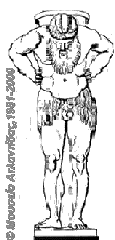
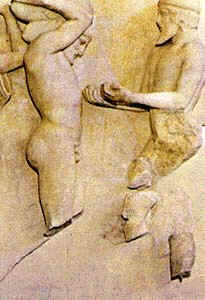
Marble statue. The Titan
Atlasin the ancient city
of Akragas
The mythical figure Atlas is presented closely related to Arcadia (in Peloponnese). In Arcadia, Atlas was worshiped like a "god". The Greek tradition identified this Atlas from about 2000 to 600 according to the old calendar with the previous Atlantes and recognized him as father of the Pleiades. It was accepted that the Pleiades were born on a mountain of Killini in the north of Arcadia. It is said that in a cave of this mountain Maea gave birth to Hermes (Zeus was the father).
The ancient Arcadians called themselves "offspring of the daughters of Atlas" (see F.H.G. Didot). Mountain Killini was previously named "mount Atlas" to honor the "god" (read king) Atlas. Arcadia was previously named Gigantis, land of the giants. But when in the 6th century BC the epics of Homer and poems of Hesiod were recorded in the then language and analyzed, and when later Solon brought information from Egypt about Atlantis and Plato published it, and when the Greeks while traveling broadened the geographical horizon, the mystic stories about Atlas of Arcadia changed… The origin of the old local god Atlas was transferred from Arcadia to the Far West. So now everyone accepted that Atlas of Arcadia was the first king of the region. Historian Dionysius Halicarnassus (1st century BC) studying the ancient history writes the amazing following:
"Atlas was the first king of the country that is presently called Arcadia". Zeus married his daughter Elektra and their children "who inherited Atlas's throne, reigned for a long time in Arcadia. After that there was a great flood in all Arcadia, and water covered the valleys for a long time making them unsuitable for growing".
This is where the flood of Arcadia is described by the flood of Deucalion, because in Greek mythology there is reference of only one great cataclysm, the one of Deucalion.
So everyone accepted that Atlas of Arcadia was the first king of the region and he came from the west. He seems to be a relative or offspring of Atlas III (the central king of Atlantis) and when the Atlanteans conquered Peloponnese they made him king and deputy. The fact that Arcadia was previously called Gigantis (land of the giants) allows us to assume that Atlas was also the chief of the group of the Titans or Giants who settled there. A mountain of Arcadia was named Atlas after him (the mountain that was later called Killini). Another mountain was named Azan after his Atlantian consul or brother Azan or Azais. Atlas IV and the power of the Atlanteans that followed him and settled in Arcadia had offspring. This is why the ancient Arcadians said they came from the Atlanteans. After the cataclysm of Deucalion the destruction of Arcadia human civilization started from the beginning. The survivors of the cataclysm kept in their memory and orally transmitted to the new generation the power of Titans, Giants and Atlanteans. The new generations and the next heard of things they had never thought before. So they slowly deified Atlas. Atlas of Arcadia was the last of the eminent offspring of the Titans of the generation of Iapetus and Poseidon.
Copyright © 2000 by

|
Atlas with Heracles and Perseus |
|
|
When Heracles acting in one of his labors had to bring to Evristheus, king of Mycenae, the gold apples of Hesperides, he met in the far east Atlas and accepted to hold the dome for a while until the giant gets him the apples. Getting back Atlas refused to take the dome back and proposed to take the apples to Eurystheus himself. Heracles pretended he agreed but asked him to take the dome back for a while to make a "cushion" for his head. Atlas fell into the trap and Heracles took the apples and left. So Atlas kept on his duty.
Having the apples the hero returned to Mycenae and gave them to Eurystheus. But he gave them to him as a present. After that Heracles gave them to "goddess" Athena who returned them to the garden of Hesperides "because it was not allowed to be anywhere else".
Hesiod talks about all of the above. He also says in Theogony that Heracles traveled to Hesperides inside a sailing bronze earthenware jar. Nireus was his guide, son of Pontus or Poseidon who took Heracles from the Mediterranean passed through Cronus's Columns (this was the name of Gibraltar, later called Heracles's columns), sailed the Atlantic and got to the Hesperides islands.
Others said that Heracles managed to kill the thieves who had grabbed Atlas's daughters, Hesperides, and bring them safe and sound back to their father, who out of gratitude taught Heracles the secrets of the sky and astronomy.
In the far west he went to find Atlas and another great hero, Perseus son of Danae (daughter of Acrisius and Eurydice) and Zeus. But Atlas did not welcome him and tried to kill him. Then Perseus showed him the head of Medusa (or Gorgo) and froze him. So Atlas became a big mountain in Africa or somewhere further named Atlas.
Another "demigod" related to the Atlanteans was Heracles (or Hercules). Plutarchus from the information he got concluded that he was a historic person although there were many myths about him.
So Heracles traveled to Atlantis with "a sailing bronze earthen jar". Nireus, who was the son of Pontus and was closely related to Poseidon, led him. Homer says about Nireus that :"he ruled the Mediterranean under the orders of Poseidon" (Iliad l.141). Nireus and Oceanid Doris gave birth to the 77 Niriades (daughters (nymphs) of the sea that is they were thought as sea "goddesses"). Here myth reveals in our opinion Nireus's identity, that he was the captain who under the orders of Poseidon ruled a whole fleet of 77 ships. So Nireus, the captain of the Atlanteans, led Heracles to Atlas by boat.
From the narration of the meeting between Atlas and Heracles it is clear that Atlas made Heracles an ally, who helped him for a while to rule Atlantis ("he hold for a while the dome, Atlas's burden"). An agreement is possible to have happened or sharing of the power between The Greeks and Atlanteans with the Hercules's Columns as border that is the two rocks in the Gibraltar passage. Maybe we can explain this way the change of its name from "Cronus's Columns" to "Heracles' s Columns".
The fact that Heracles had traveled in the Atlantic Ocean is proved by the later history of the Phoenician who when they traveled to Erythia island in the Atlantic Ocean found a temple devoted to Heracles. So how could Heracles get with an army to the Erythia Island in the Atlantic Ocean where later (in another era) the Phoenicians found his temple?
Copyright ©
Όλες οι καταγραμμένες αναφορές της Ελληνικής μυθολογίας για τον Άτλαντα
The fiction of the "gods" of ancient and prehistoric Greece. The relationship with Atlantis
| Prehistory, Atlantis and "Gods": On Bluesky and Alter TV channels | |
I discuss on T.V. with L. Georgiadi (Bluesky, 8/7/2009) :1) Prehistory and Atlantis --- 2) The content of Vassilis Paschos book "The Atlanteans and Not the Gods" |
The view of "Atlantis Museum"My interview on the TV show "Gates of the Unexplained" |
Books Presentation |
||
Science Fiction
Author: Theodoros Paschos. Pages 320 Two Greek scientists with their technology find solution to the problem of communication with intelligent beings in the universe chasing the future of humanity. Seeking to solving various mysterious phenomena starring in Mission Teams to watch the flying saucers that appear on Earth to Mars and the Moon and to communicate with extraterrestrial beings. In doing so they get involved in adventurous and dangerous stories, but they also discovered the remnants of the technology of Atlantis into the ocean depth. You can preview or get the book from the Website: smashword.com/ |
The Atlanteans and Not the Gods
Author: Vassilis Th. Paschos. Pages 350 The author Mr Vassilis Paschos, with this book penetrates research into antiquity and by demystifying legends and traditions, proves the existence of the Atlanteans. For their original residence, the cradle of its culture, their lost country, the author quotes rich material and convincing facts ... |
Atlantes, Not the "Gods"
Αuthor: Vassilis Th. Paschos. Pages 80 The new and daring theory of Mr Paschos, is based on elements from Homer, Hesiod, Plato, Proklos, Plutarch, Markellaus and other ancient Greek and Latin writers (their works are mentioned in his book), on Egyptian papyrus, the Gilgames epic poetry of Babylonians, the Bible, the traditions of the people around Mediterranian and Central America and on ancient findings in these areas. You can preview or get the book from the Website: Smasword.com/ |