|
|
The dialogue "TIMAEUS" according to PlatoIn his dialogue "Timaeus" Plato (427 - 347 B.C.) mentions among others the story which Kritias narrated which he knew by the old tradition. This story, as Kritias says, is true and it had been written since very ancient times in Solon's notes. Solon had visited ancient Egypt (in 590 B.C.) where the priests led him to the sacred town Sais in the delta of the Nile river. In that town there was the temple of Niith (Athena in Greek) which was the goddess in which believes the inhabitants as their leader and founder of the city. Inside that temple they revealed him the ancient secrets which were written in books and stones with hieroglyphic symbols. Some of the secrets that the priests translated to Solon were the following:
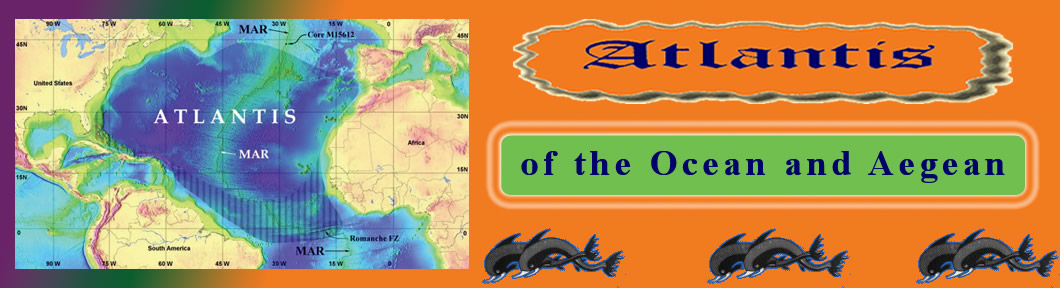
We mention, translated to the modern Greek language, what the priests of Sais told about the second subject, which interests us, to Solon (The notes in the parenthesis are ours): "...Many and great achievements of your city (note: it refers to Athens as it was before the grate cataclysm) are written here (note: it means carved in the stones of the temple of Sais) so as (the city) to be admired. However, one stands out in grandeur and heroism. Because our writing say that your city faced once a great power, which was invading at the same time, to the Europe and Asia, "coming rushingly from the Atlantic open sea". Because then, that open sea (pelagos) could be walked, because in his entrance, there was an island (land) in the mouth which you now call Hercules Stones (note: it means Gibraltar). This island was larger than Libya and Asia together, and through it travelers could go to other islands. (25) and from those islands, afterwards, to all the endless continent which was found around that real Ocean. Because these places, any of which are inside the strait which we mentioned, they look like a harbor which has a narrow entrance , those (out) however of the strait are a real ocean and the ground (land) which surrounds them can undoubtedly and very correctly be called a continent". "In this island, Atlantis, "The Atlantic island" was formed a great and wonderful power of kings which ruled the whole island and "many other islands and places of the continent". Apart from those places, mostly, from the inside part to Libya, dominated up to Egypt, and from the side of Europe until Tyrrhenia (note: this is how was West Italy called). All this power, after gathering and forming a unit, it attempted with a rushing out to enslave both yours and our place, and all the places to the inside of the narrow pass (Hercules Stones). It was then, Solon, that the power of your city shone to the eyes off all people for its heroism and its bravery. Because it surpassed everyone in courage and the arts which were enforced to war, at the beginning as head, leader of the Greeks, and later when she remained alone, when the other rebelled, after it had faced innumerable great dangers, it beat the invaders and setup triumphs. Therefore, all those who hadn't enslaved yet, it prevented them from being slaves and released bravery all the others, who lived as we did, in the inside, where are the limits of the Hercules stones". Δ. "Later, however, because happened horrible and terrifying, earthquakes and floods, a terrible a day and night was enough for all your army to disappear all at once. The earth opened and shallowed them and after that sang and disappeared the island of Atlantis. For this reason, until now, that pelagos is impassable and unexplored because it really impedes the mass of mad to the shallow rocks which were left in that place after the sinking of the island..." Copyright © by
|
Copyright © by Theodoros Paschos, Greece, 2000
|
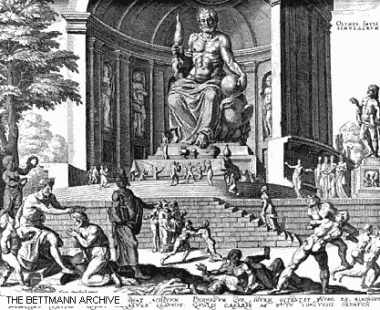
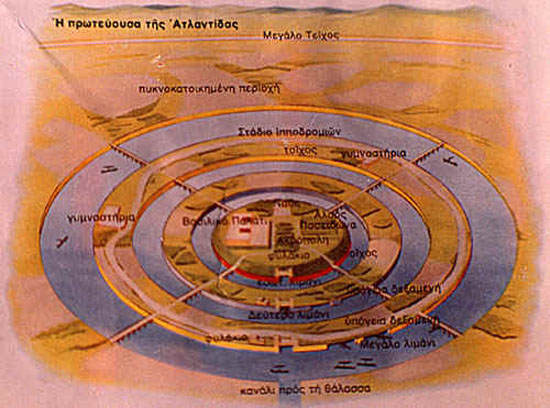
Plato, in his dialogue of “Critias”, after having been primarily referred in the war between Athenians - Atlanteans and the "Genealogy of the Atlanteans" (see here), is then referred to their progress in technology and to their most important technical achievements. The favourable climate and the rich subsoil played a vital role in this progress. The translation of the text is word-by-word: "...The country was rich and productive. There was abundance in all goods of life. Atlantis was distinguished for its expanded flora. Its vegetation was luxuriant. There were many tall and big trees, with plenty of vegetables, soft and dried fruits. It fed many tame and wild animals, and a great number of domesticated elephants. The subsoil was rich in noble and valuable metals, mainly copper, bronze, gold, silver and tin. Bronze was evaluated after gold. They also used ivory mostly in decorations. The climate and environment, “the dominant mild temperature of seasons”, was ideal for the evolution of people’s intelligence, high virtues, sobriety, discernment, power and grandeur. All the inhabitants were pro-labor, progressive and gradually developed an enviable and incomparable civilization. They constructed mines and foundries, and also small industries where they elaborated metals used also in their dreamlike constructions. All the necessary means for their life and their tools were made of fine metals. The emblems of kings and leaders, the sacred ware, the craters and cups for the libations and the ornaments were all made of pure gold. Many of their statues were made of gold and ivory together with silver and bronze. They constructed grandeur structures, majestic palaces and other mansions, temples, altars, big bridges, arches, harbors, shipyards and navy yards, canals, artificial lakes, large boats, chariots and plenty of statues, monuments, tombs and pyramids. Their temples were made of colored boulders and those of great importance were covered by golden, silver, tin or bronze plates. The temples had a trapezoid shape. The central palace was gorgeous. It stood imposing on a hill. Its walls were built with huge carved stones in black, white and red color, ornamented with tin. On the one hand they chopped the huge stones in order to build the mansions in the stony soil and on the other hand they constructed in the interior two deep store rooms for boats, having the same roof of rock. The wall of the Acropolis was faced with bronze, that seemed as if shining through flames. In Acropolis there was situated the beautiful temple of Poseidon, made of ivory and gold. The statue of god was stood in a chariot with six winged horses and it was so high that reached the roof of the temple. It was surrounded by one hundred Nereids sitting on delphins. The altar was also found in the Acropolis and was similarly beautiful as the temple. There were still plenty of statues. The mansions and the Acropolis were surrounded by water rings connected with passages that led to the center. The passages were blocked by gates placed between towers - guardhouses - and above them there were bridges. Their opening had space for a trireme, which could sail underground below the bridges. The water rings of the Acropolis were connected with sea - which was fifty stadions (9.250 meters) apart - by a canal of three square measures (88,71 meters) width and one hundred feet (25 meters) depth. At the edge of the canal there was a vast entry with a great capacity for the boats to pass through rings. The big harbor near Atlantis, the capital of the united kingdom, was spacious and always full of boats and merchants from all over the world. The stores for the ships were full of triremes and enough equipment placed in order. The fleet of Atlantis was consisted of 1.200 different boats. Regarding their other constructions, many of them were made of colorful blended stones that looked exquisite. They constructed, in the fertile land, an artificial lake of ten thousand stadions (1.850 square kilometers), where they conveyed the surplus of water for the summer. The lake water was channeled through ditches and dikes to the plain in order to water the fields. In this way, they regulated cultivation and mowed twice a year! In the sacred forest of Poseidon, there were springs with cold and hot water and roofed outdoor tanks. In Atlantis, there were also gardens with plants and flowers, gymnasiums and a hippodrome. Up on the hills, they constructed lakes with dams, connected with wide dikes and rivers coming from the plain. In these lakes, they accumulated the pieces of wood, chopped them and then released water so as to sweep them off the dikes towards the plain." ...and the dialogue of “Critias” by Plato continues with the "Administration of the State" (see here).
(Museum of Atlantis): Representation of Atlantis structure formed in
Copyright © by
|
Copyright © by Theodoros Paschos, Greece, 2000
|
| Prehistory, Atlantis and "Gods": On Bluesky and Alter TV channels | |
I discuss on T.V. with L. Georgiadi (Bluesky, 8/7/2009) :1) Prehistory and Atlantis --- 2) The content of Vassilis Paschos book "The Atlanteans and Not the Gods" |
The view of "Atlantis Museum"My interview on the TV show "Gates of the Unexplained" |
Books Presentation |
||
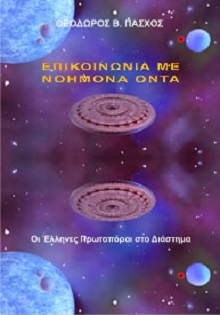
Science Fiction
Author: Theodoros Paschos. Pages 320 Two Greek scientists with their technology find solution to the problem of communication with intelligent beings in the universe chasing the future of humanity. Seeking to solving various mysterious phenomena starring in Mission Teams to watch the flying saucers that appear on Earth to Mars and the Moon and to communicate with extraterrestrial beings. In doing so they get involved in adventurous and dangerous stories, but they also discovered the remnants of the technology of Atlantis into the ocean depth. You can preview or get the book from the Website: smashword.com/ |
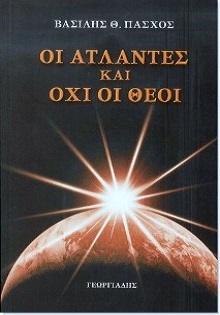
The Atlanteans and Not the Gods
Author: Vassilis Th. Paschos. Pages 350 The author Mr Vassilis Paschos, with this book penetrates research into antiquity and by demystifying legends and traditions, proves the existence of the Atlanteans. For their original residence, the cradle of its culture, their lost country, the author quotes rich material and convincing facts ... |
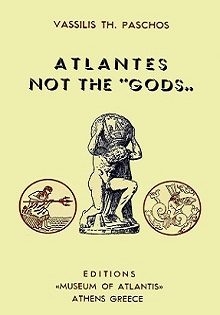
Atlantes, Not the "Gods"
Αuthor: Vassilis Th. Paschos. Pages 80 The new and daring theory of Mr Paschos, is based on elements from Homer, Hesiod, Plato, Proklos, Plutarch, Markellaus and other ancient Greek and Latin writers (their works are mentioned in his book), on Egyptian papyrus, the Gilgames epic poetry of Babylonians, the Bible, the traditions of the people around Mediterranian and Central America and on ancient findings in these areas. You can preview or get the book from the Website: Smasword.com/ |